
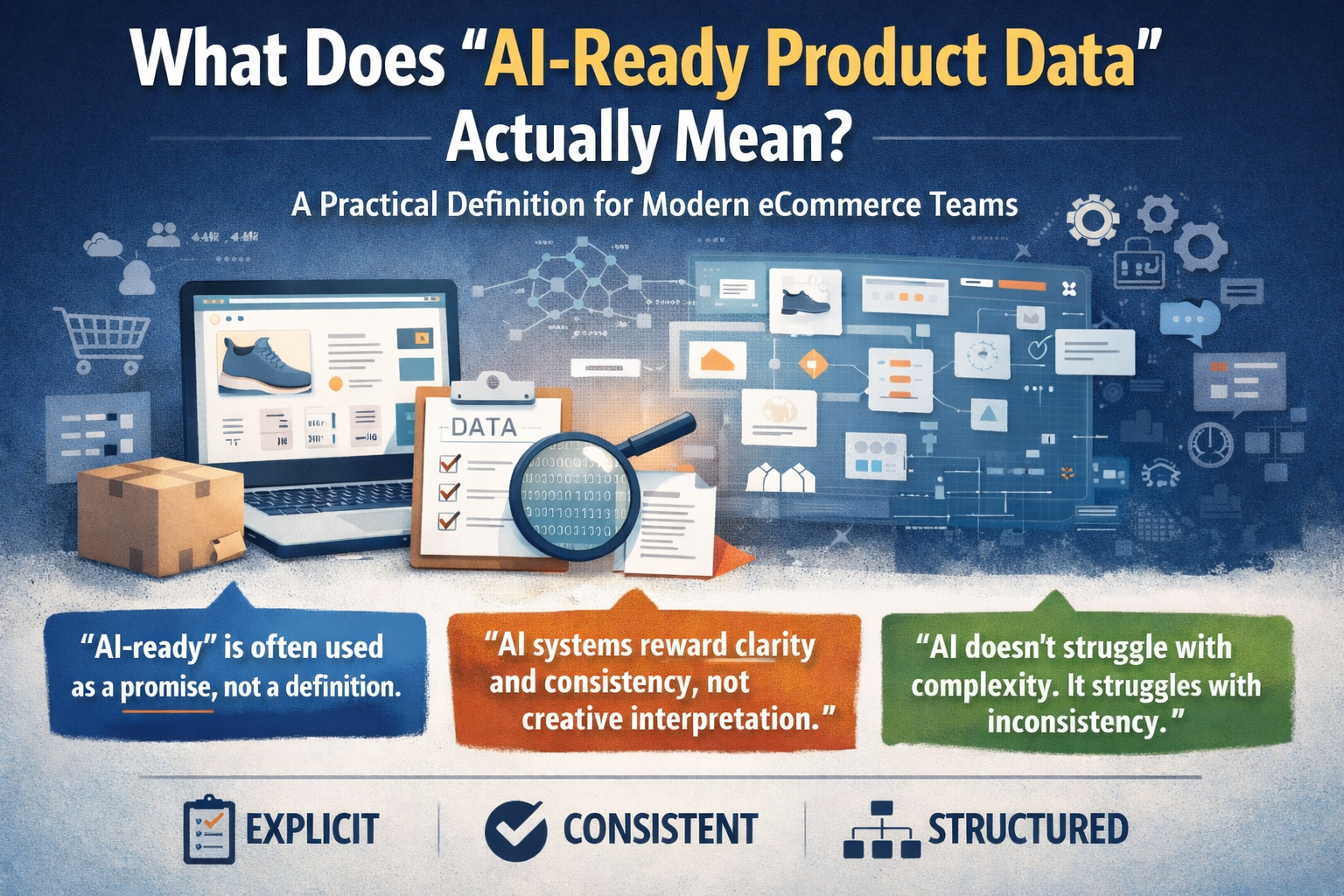
A Practical Definition for Modern eCommerce Teams
“AI-ready” has quickly become a catch-all phrase in eCommerce. Product data is described as AI-ready. Catalogs are said to be AI-ready. Entire platforms claim to make commerce AI-ready by default.
In practice, the term is rarely defined.
For many teams, “AI-ready” simply means data exists in a system that an AI tool can access. For others, it implies automation, enrichment, or future-proofing. These interpretations are broad, optimistic, and often misleading.
As AI systems become more deeply embedded in search, shopping, advertising, and discovery, this lack of clarity becomes a problem. Without a shared understanding of what AI-ready product data looks like, teams struggle to prepare their catalogs in a meaningful way.
“AI-ready” is often used as a promise, not a definition.
Why the Term Matters Now
In earlier phases of eCommerce, product data was primarily consumed by humans. Even when systems were involved, interpretation played a larger role. Copy could fill gaps, and manual intervention could correct issues as they appeared.
AI changes this dynamic.
Modern AI-driven systems do not interpret ambiguity well. They rely on explicit, repeatable inputs to generate outputs at scale. As AI increasingly influences how products are surfaced, compared, summarised, and recommended, the tolerance for unclear or inconsistent data drops sharply.
In this context, “AI-ready” is not a marketing label. It describes whether a catalog can be reliably used by systems that operate without human judgment.
What AI Systems Actually Need From Product Data
To understand what AI-ready means, it helps to understand how AI systems consume product information.
Unlike humans, AI models do not infer intent from tone or context in the same way. They depend on patterns, consistency, and explicit signals across large datasets. When those signals are missing or contradictory, outputs degrade quickly.
At a high level, AI-ready product data has three defining characteristics:
- It is explicit, not implied
- It is consistent across the catalog
- It is structured in a way machines can reliably process
AI systems reward clarity and consistency, not creative interpretation.
This does not mean product data must be perfect. It means ambiguity must be minimised.
The Difference Between “Complete” and “AI-Ready”
A common misconception is that AI-ready product data simply means “fully populated” product records. While completeness matters, it is not sufficient on its own.
A catalog can be technically complete and still perform poorly in AI-driven systems if:
- Attributes are filled inconsistently
- Terminology varies between similar products
- Product roles within a category are unclear
AI-ready data is less about volume and more about reliability. Systems need to trust that the same fields mean the same things everywhere in the catalog.
Where AI-Readiness Breaks Down in Practice
Most catalogs were not designed with AI consumption in mind. They evolved to support merchandising, publishing, and feed requirements over time.
As a result, AI-readiness often breaks down in predictable ways:
- Attributes are optional rather than enforced
- Similar products are described differently
- Variants are handled inconsistently
- Descriptions compensate for missing structure
AI doesn’t struggle with complexity. It struggles with inconsistency.
When AI tools are layered on top of this data, they expose these weaknesses rather than resolving them. Outputs become generic, inaccurate, or overly cautious because the inputs lack clarity.
What AI-Ready Product Data Looks Like in Practice
AI-ready product data does not require a radical rebuild. It requires a shift in priorities.
In AI-ready catalogs:
- Core attributes are consistently defined and enforced
- Products are clearly differentiated within categories
- Variants follow predictable patterns
- Descriptions reinforce structured data instead of replacing it
Most importantly, quality is maintained through process, not manual heroics. Teams focus on reducing ambiguity rather than adding more content.
AI-driven enrichment can support this by standardising attributes, filling known gaps, and applying consistent rules at scale. Used correctly, it helps teams improve reliability incrementally without disrupting day-to-day operations.
AI-ready product data is reliable data, not perfect data.
Why AI-Readiness Is a Moving Target
AI-readiness is not a one-time achievement. As catalogs change, categories evolve, and systems become more capable, expectations shift.
This is why teams that treat AI-readiness as a project often struggle to maintain it. Sustainable readiness comes from embedding clarity and consistency into catalog processes, not from periodic clean-ups.
The goal is not to anticipate every future AI use case, but to ensure product data can adapt without constant rework.
Key Takeaways
- “AI-ready” product data must be defined, not assumed.
- AI systems depend on explicit, consistent, and structured inputs.
- Completeness alone does not make product data usable by AI.
- Inconsistency is a larger risk than complexity for AI systems.
- AI-readiness is best achieved incrementally through process, not one-off projects.
Frequently Asked Questions
Closing Perspective
AI-ready product data is often framed as a future requirement. In reality, it reflects a present shift in how commerce systems operate.
Teams that invest in clarity, consistency, and structure today are not just preparing for AI. They are making their catalogs easier to manage, optimise, and scale across every system that depends on them.
Summary
AI-ready product data is defined by clarity, consistency, and structure, enabling AI systems and automated commerce platforms to reliably understand and optimise products at scale.