
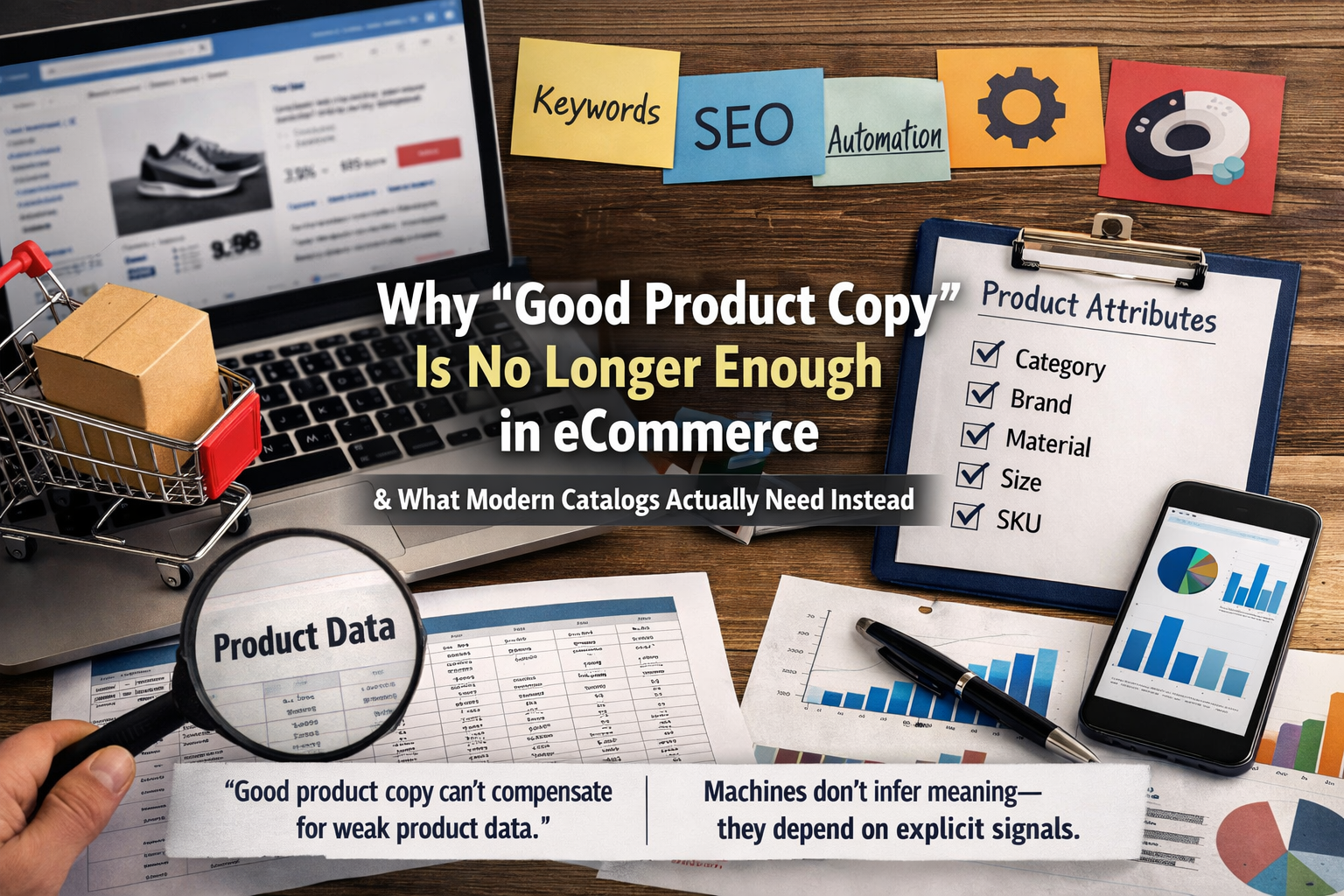
Why “Good Product Copy” Is No Longer Enough in eCommerce
And What Modern Catalogs Actually Need Instead
For years, improving product performance in eCommerce often meant improving product copy. Longer descriptions, better storytelling, clearer benefits, and more persuasive language were seen as the primary levers for increasing visibility and conversion.
That approach is no longer sufficient.
While good copy still matters, it is no longer the primary factor determining how products are discovered, matched, and optimised across modern eCommerce systems. Today, performance depends less on how well a product is described for humans and more on how clearly it is defined for machines.
This shift is subtle but significant. Many teams continue to invest heavily in copy improvements while overlooking deeper structural issues in their catalog. As a result, they see diminishing returns from content work that once delivered meaningful gains.
“Good product copy can’t compensate for weak product data.”
How Product Copy Became the Default Fix
Historically, product copy filled the gaps left by limited structure. When attributes were sparse or inconsistent, descriptions carried the burden of explaining what a product was, how it differed, and why it mattered. Search engines were more forgiving, shopping platforms were simpler, and catalogs were easier to manage manually.
In that environment, improving copy often produced real results. Better descriptions helped pages rank, reduced customer confusion, and increased conversion rates. Over time, this reinforced the belief that copy was the primary driver of product performance.
That belief persisted even as the underlying systems evolved.
Today, most discovery, advertising, and automation systems no longer rely on descriptive prose to infer meaning. They rely on explicit, structured signals that can be processed consistently across thousands of products. Copy still plays a role, but it is no longer the foundation.
This mindset made sense when catalogs were smaller and systems were simpler, but as commerce platforms evolved, the underlying cost of weak product data became harder to ignore — a dynamic explored in the hidden cost of poor product data in eCommerce.
Where “Good Copy” Starts to Break Down
As catalogs grow and systems become more automated, the limitations of copy-first approaches become more visible.
Search and Discovery
Search engines increasingly prioritise clarity, structure, and consistency across product pages. While descriptive language helps with context, it cannot reliably replace missing or inconsistent attributes. Products with similar descriptions but poorly defined differences often compete against each other, diluting visibility rather than strengthening it.
Shopping Feeds and Automation
Shopping platforms and automated ad systems depend heavily on structured fields to determine eligibility, relevance, and matching. Descriptions are secondary. When attributes such as category, material, size, or variant data are incomplete or inconsistent, no amount of well-written copy can fully offset the resulting gaps in coverage or performance.
AI-Driven Experiences
AI systems make the limitations of copy-first approaches even clearer. When asked to summarise, compare, or recommend products, AI models depend on structured inputs to produce accurate outputs. Copy that implies features or attributes without stating them explicitly introduces ambiguity, which often leads to generic or incorrect results.
“Machines don’t infer meaning the way humans do. They depend on explicit signals.”
Why Copy-Centric Strategies Fail at Scale
Small catalogs can often get away with relying on strong copy. Large catalogs cannot.
As SKU counts increase, maintaining high-quality, consistent copy across thousands of products becomes operationally difficult. Writers interpret products differently, standards drift, and subtle inconsistencies accumulate. Over time, the catalog becomes uneven, even if individual descriptions appear well written in isolation.
Teams respond by introducing templates, style guides, and QA processes. While these measures improve consistency, they also increase cost and slow iteration. More importantly, they do not address the underlying issue: copy is being asked to do work that structured data should handle.
“At scale, copy becomes a bottleneck rather than a differentiator.”
As a result, catalogs become harder to maintain, harder to optimise, and less adaptable to new platforms or systems.
The Shift From Persuasion to Definition
Modern eCommerce systems care less about persuasion and more about definition. They need to understand, with precision, what a product is and how it relates to other products in the catalog.
This requires:
- Explicit attributes rather than implied ones
- Standardised terminology across products
- Clear differentiation between similar SKUs
When these elements are missing, copy is often stretched beyond its intended role. Descriptions become longer, more repetitive, and more complex, yet performance stagnates because the underlying structure remains weak.
“Copy persuades humans. Structure enables systems.”
What Modern Catalogs Need Instead
Strong product copy still has value, but it should reinforce a well-defined system rather than compensate for its absence.
In effective catalogs:
- Structured attributes define the product clearly
- Copy supports positioning and nuance
- Metadata aligns with actual product characteristics
- Consistency is enforced across the entire catalog
This shift reduces the burden on copy while improving performance across channels. Products become easier to surface, match, and optimise, and content work delivers more predictable results.
AI-driven enrichment can support this approach by helping teams standardise attributes, fill gaps consistently, and apply rules at scale. When used within a structured process, AI reduces manual effort without sacrificing clarity or control.
Key Takeaways
- Good product copy remains important but is no longer sufficient on its own.
- Modern eCommerce systems rely on structure and explicit signals, not inference.
- Copy-first strategies break down as catalogs scale.
- Clear definition matters more than persuasive language for machines.
- The most effective catalogs treat copy as support, not infrastructure.
Frequently Asked Questions
Closing Perspective
The belief that better copy alone will drive better performance is rooted in an earlier phase of eCommerce. As platforms, automation, and AI continue to evolve, that belief becomes increasingly limiting.
Modern catalogs succeed not because they say more, but because they define products more clearly. Teams that recognise this shift will find it easier to scale, adapt, and extract value from both human creativity and machine-driven systems.
Summary
Good product copy alone can no longer support modern eCommerce performance, as search engines, shopping platforms, and AI systems increasingly rely on structured product data rather than descriptive prose.