
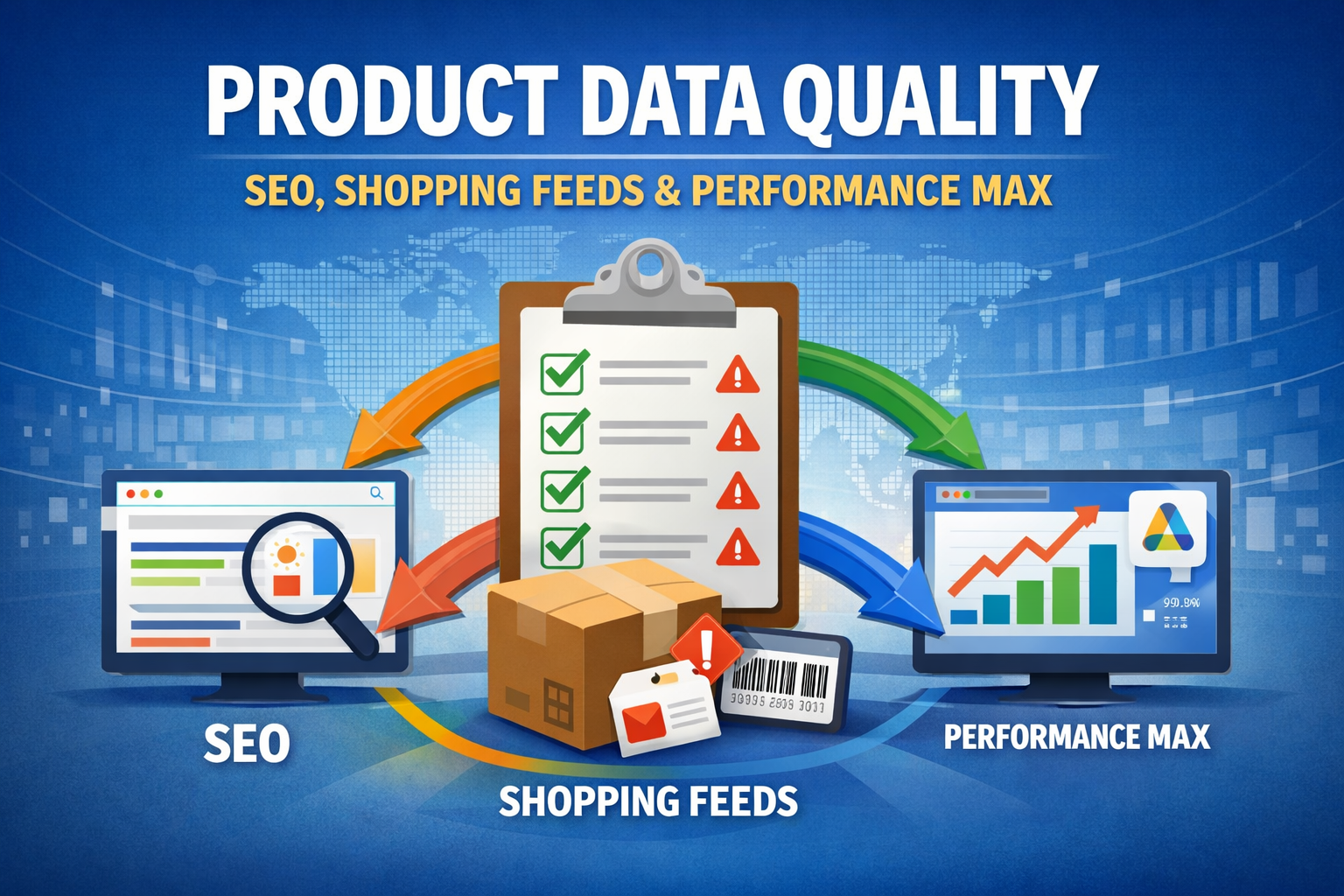
Why Modern Growth Systems Depend on the Same Inputs
Most eCommerce teams optimise performance by channel. SEO is treated separately from paid media. Shopping feeds are managed independently from site content. Performance Max is often handled as a black box that requires constant tuning.
Despite this separation, all of these systems rely on the same underlying inputs. Product data quality plays a decisive role in how effectively modern commerce platforms understand, surface, and optimise products.
When that data is incomplete or inconsistent, performance issues appear across channels—even when strategies, budgets, and execution are sound.
This is why teams often feel like they are fixing the same problems repeatedly in different places. The root cause is shared, even if the symptoms are not.
“Modern commerce systems optimise differently, but they all depend on the same product data.”
Why Channel-Level Optimisation Plateaus
Historically, it made sense to optimise channels independently. SEO teams focused on keywords and content. Paid teams focused on bidding and creative. Feed management was largely operational.
As platforms became more automated, this separation became less effective. Search engines, shopping platforms, and Performance Max now rely heavily on structured product data to make decisions at scale.
When that data is weak, channel-level optimisation delivers diminishing returns because the systems themselves lack clarity.
The result is a familiar pattern: more effort, more tooling, more iteration—without corresponding gains.
SEO: Structure Determines Visibility, Copy Supports Performance
In organic search, product data quality directly influences how search engines interpret relevance and differentiation.
When attributes are incomplete or inconsistent, search engines struggle to understand:
- What a product actually is
- How it differs from similar products
- Which queries it should reliably rank for
This often leads to weak long-tail visibility and internal competition between similar SKUs. Teams may respond by improving copy or expanding templates, but these efforts rarely resolve the underlying ambiguity.
Clear structure enables search engines to build confidence in product pages. Without it, rankings tend to plateau regardless of ongoing optimisation.
“Search engines struggle with unclear products, not short descriptions.”
Shopping Feeds: Eligibility, Stability, and Coverage
Shopping platforms depend more heavily on structured attributes than any other channel. Category mappings, variants, availability, and product characteristics all affect eligibility and performance.
When this data is inconsistent:
- Products drop in and out of feeds
- Disapprovals increase
- Coverage becomes unpredictable
Teams often fix these issues reactively, addressing errors as they appear. While this keeps feeds running, it does not improve their underlying stability.
Over time, optimisation becomes maintenance-heavy. Performance improves temporarily, then degrades again as catalog complexity increases.
Performance Max: Automation Amplifies Input Quality
Performance Max relies on automation across targeting, creative, and placement. This automation is only as effective as the inputs it receives.
Product data quality affects:
- Matching accuracy
- Asset relevance
- Learning stability
When products are poorly defined, Performance Max behaves inconsistently. Some SKUs perform well while others stagnate, even within the same category.
More optimisation does not necessarily fix this, because the system lacks the clarity required to generalise performance.
“Automation doesn’t remove the need for quality inputs. It amplifies their importance.”
The Common Failure Pattern Across Systems
Although SEO, Shopping, and Performance Max operate differently, the failure pattern is the same.
Inconsistent product data creates uncertainty. That uncertainty limits how confidently systems can surface, match, and optimise products.
The result is volatility, inefficiency, and a growing reliance on manual intervention.
Teams often treat these issues as channel-specific problems, but they are manifestations of the same structural weakness.
Why Fixes at the Channel Level Don’t Last
Channel-specific fixes can improve performance in the short term. However, they rarely scale.
As catalogs grow:
- Exceptions increase
- Rules become harder to maintain
- Manual QA expands
Eventually, teams reach a point where maintaining performance requires more effort than improving it.
“When product data is weak, every channel fix becomes temporary.”
What This Means for eCommerce Teams
Improving product data quality creates leverage across all growth systems simultaneously.
When product data is clear, consistent, and complete:
- SEO gains are more durable
- Shopping feeds become more stable
- Performance Max behaves more predictably
Most importantly, improvements compound. Fixing product data once improves multiple systems at the same time, reducing operational load rather than increasing it.
AI-driven enrichment can support this process by applying structure at scale, filling gaps consistently, and reducing repetitive manual work. Used correctly, it enables teams to improve data quality incrementally without disrupting ongoing operations.
Key Takeaways
- SEO, Shopping feeds, and Performance Max all rely on the same underlying product data.
- Weak product data limits system confidence and performance across channels.
- Channel-level optimisation delivers diminishing returns when data quality is poor.
- Automation increases dependence on clear, consistent inputs.
- Improving product data at the source creates compounding performance gains.
Frequently Asked Questions
Closing Perspective
Modern eCommerce performance is increasingly driven by systems that operate at scale. While strategies and execution still matter, they are constrained by the quality of the inputs those systems receive.
Teams that continue to optimise channels in isolation will see diminishing returns. Teams that improve product data at the source will unlock more durable, predictable performance across every channel that depends on it.
Summary
Product data quality directly affects SEO, Shopping feeds, and Performance Max because modern commerce systems rely on the same structured inputs to surface, match, and optimise products at scale.